The Cost of Caution: How Risk Aversion Is Quietly Strangling Creative Ambition in American Media Production
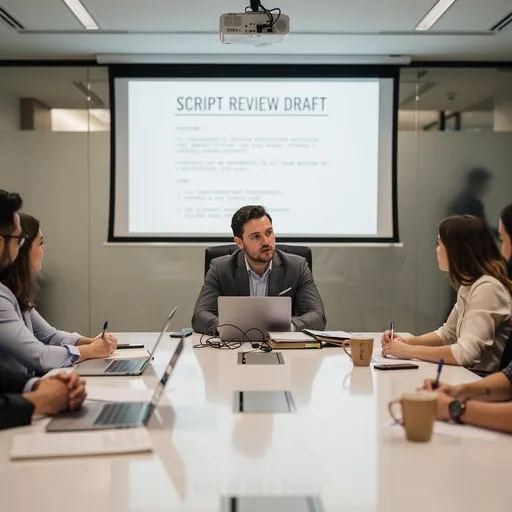
Photo: film producer reviewing documents in production office boardroom, via legalwisehub.com
Somewhere between the legal department's third revision and the insurance underwriter's fourth addendum, the boldest version of a story quietly disappears. It does not leave with a dramatic exit. It simply fades — trimmed here, softened there, until what remains is a production that is technically defensible, institutionally approved, and creatively diminished.
This is the quiet crisis in American media production. Not the headline-grabbing budget overruns or the streaming wars or the existential anxiety over theatrical box office. The more corrosive problem is systemic: a culture of institutional gatekeeping that has reframed creative courage as professional liability.
When Process Became the Product
The modern production pipeline was not always this heavily fortified. Throughout the 1970s and into the independent film boom of the 1990s, producers operated with a degree of creative latitude that would be virtually unrecognizable today. Decisions were made on set, in the edit bay, in conversation — not through layers of pre-approved frameworks designed to minimize exposure.
What changed was not ambition. What changed was scale, corporate ownership, and the financialization of creative risk. As major studios were absorbed into multinational conglomerates and as streaming platforms began functioning more like technology companies than entertainment houses, the vocabulary of production shifted accordingly. Suddenly, stories were being developed inside ecosystems built to protect shareholder value, not to champion a filmmaker's vision.
The result is a production environment in which asking for forgiveness — the old entrepreneurial instinct to act boldly and course-correct later — has been systematically replaced by asking for permission at every conceivable juncture. Legal clearances. Errors and omissions insurance requirements. Diversity and inclusion audits that, however well-intentioned, are frequently deployed as bureaucratic checkpoints rather than genuine tools of creative enrichment. Format approvals. Brand safety reviews. Platform-specific content guidelines that effectively function as invisible censorship.
Each individual step is defensible. Collectively, they constitute a gauntlet that punishes originality.
The Real Price Tag of Over-Legalization
The financial costs of this institutional machinery are rarely discussed with candor. Industry insiders acknowledge — typically off the record — that a significant portion of a mid-budget production's overhead now flows directly into compliance, clearance, and coverage infrastructure rather than into the creative work itself.
But the financial drain, while substantial, is arguably the lesser cost. The deeper damage is temporal and psychological. Creative decision-making in a permission-saturated environment becomes slower, more tentative, and increasingly divorced from the instincts that produce memorable work. Directors begin self-censoring before a single note arrives from above. Writers anticipate legal objections and preemptively sand down the edges of their narratives. Producers, caught between creative talent and institutional gatekeepers, learn to manage expectations downward rather than advocate upward.
The cumulative effect is a kind of creative erosion that is difficult to quantify but unmistakable in the finished product. Audiences sense it even when they cannot name it. A story that has been committee-approved into safety carries a particular texture — competent, inoffensive, and somehow airless.
Producers Who Chose a Different Path
The most instructive counterexamples are not always the loudest ones. Some of the most creatively vital American productions of the past decade were made by producers who deliberately engineered their projects to exist outside the permission architecture of major institutional pipelines.
A24's early model — now widely studied, less widely replicated — was built on the premise that creative trust was a competitive advantage, not a liability. By keeping overhead lean and decision-making chains short, the company enabled filmmakers to take formal and narrative risks that larger institutional players would have negotiated away long before production began.
Similarly, producers working in the documentary space have long operated with a different calculus. Werner Herzog's famous dictum that a filmmaker must be willing to act — to move, to decide, to commit — before the bureaucratic apparatus catches up remains a working philosophy for a generation of nonfiction storytellers who have built careers on productive irreverence toward institutional process.
On the television side, the early seasons of productions like The Wire and Deadwood succeeded in part because their showrunners were granted unusual degrees of autonomy from network interference. The results were not merely commercially successful; they recalibrated audience expectations for what the medium could achieve. That recalibration required someone, at some level, to choose creative ambition over institutional comfort.
Redefining Responsible Production
None of this is an argument against legal compliance, worker safety, or ethical accountability. Those obligations are real and non-negotiable. The argument, rather, is about proportion and intent.
When risk management frameworks are designed primarily to protect institutional actors from liability rather than to support the creative process, they function as a tax on imagination. The question the industry must begin asking more honestly is not how do we protect ourselves from this story? but rather what are we losing by refusing to tell it fully?
Responsible production, properly understood, is not the same as cautious production. Responsibility to the audience — the obligation to deliver work of genuine meaning and craft — sometimes demands exactly the kind of bold, instinct-driven decision-making that institutional gatekeeping is specifically designed to prevent.
The producers and directors who have consistently delivered the most enduring work in American media are rarely those who navigated the permission architecture most skillfully. They are, more often, those who found ways to protect the creative core of their projects from that architecture entirely.
A Necessary Reckoning
The industry is at an inflection point. Streaming consolidation, tightening production budgets, and an increasingly restless audience are all creating pressure for a fundamental reassessment of how content gets made. That reassessment, if it is to be genuinely productive, must include an honest accounting of what institutional risk aversion is costing us — not in legal exposure or quarterly earnings, but in stories that were never told, visions that were never realized, and audiences that were never moved.
At Principe Productions, the guiding conviction is that stories capable of moving the world require producers willing to accept that the world sometimes pushes back. The permission culture of modern American media production is not a neutral administrative reality. It is a choice — and like all choices in storytelling, it has consequences that extend far beyond the balance sheet.