When Words Step Aside: The Quiet Revolution Transforming Modern Cinema

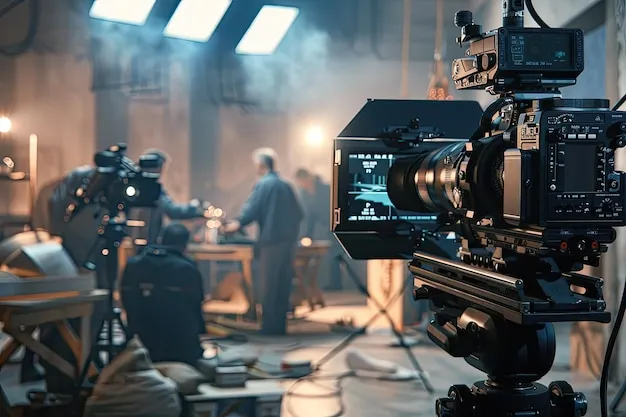
Photo: William Vasta, Public domain, via Wikimedia Commons
There is a particular kind of confidence required to tell a story without words. It demands that a filmmaker trust the frame entirely — that a gesture, a shaft of light, or the ambient sound of an empty room can accomplish what pages of carefully written dialogue cannot. Increasingly, that confidence is defining some of the most celebrated work in American cinema.
Across studios and independent productions alike, a deliberate minimization of verbal exposition has emerged as one of the defining craft tendencies of the current decade. Directors are choosing silence not out of creative limitation, but as a form of precision — a recognition that audiences, shaped by decades of visual media literacy, are more than capable of reading a scene without being told what it means.
The Craft Argument for Cutting Lines
At its most technical level, the case for dialogue reduction begins in the editing room. Every line of spoken exposition introduces a dependency — the viewer must process language, attribute meaning, and reconcile what is said with what is shown. When those two channels conflict, cognitive dissonance follows. When they simply duplicate each other, the result is redundancy that slackens a film's emotional tension.
Cinematographers and directors working in the dialogue-light tradition often describe their process as one of subtraction. Rather than building scenes outward from a script, they work inward — identifying the precise emotional transaction a scene must accomplish and then removing every element, verbal or otherwise, that does not serve that transaction directly.
The results can be striking. Consider the wordless sequences in recent prestige productions where entire character arcs pivot on a single held expression or a carefully composed environment. These moments tend to linger in audience memory far longer than any piece of delivered exposition, precisely because they require active interpretation. The viewer becomes a participant rather than a recipient.
Visual Language as the Primary Instrument
The tradition of visual storytelling in American film stretches back to the silent era, but its contemporary practitioners are working with a significantly expanded toolkit. Advances in camera technology, color grading, and spatial sound design have made it possible to communicate psychological states with extraordinary nuance — without a single spoken word.
Filmmakers such as Chloe Zhao, whose work on Nomadland demonstrated how landscape itself could function as interior monologue, and the creative teams behind productions like The Lighthouse and Past Lives have shown that restraint in dialogue does not mean restraint in meaning. If anything, the opposite tends to be true. By removing verbal scaffolding, these films invite viewers into a more intimate interpretive relationship with the material.
This is not accidental. It reflects a studied understanding of how meaning is constructed in the viewing experience. When a character's emotional state is narrated aloud, the audience receives a finished product. When it is rendered through composition, performance, and sound, the audience completes the circuit themselves — and that act of completion creates a far more durable emotional investment.
What Audiences Are Actually Responding To
The psychology of this phenomenon is worth examining carefully. Research into media consumption consistently suggests that viewers retain emotionally charged visual information more reliably than verbal content. This is not a new finding, but its implications for narrative filmmaking are only now being fully absorbed by mainstream production culture.
American audiences, in particular, have undergone a significant evolution in visual literacy over the past two decades. The proliferation of international cinema through streaming platforms has exposed viewers to storytelling traditions — South Korean, Scandinavian, Japanese — that have long prioritized visual and tonal communication over dialogue-heavy exposition. That exposure has recalibrated expectations in ways that Hollywood is only beginning to fully register.
There is also a generational dimension to consider. Younger viewers who have grown up consuming content across multiple formats — social video, gaming, interactive media — have developed a comfort with non-linear and non-verbal narrative that their predecessors did not necessarily share. For this audience, a film that trusts them to interpret rather than simply receive is not a challenge. It is a form of respect.
The Production Implications
For studios and production companies, the shift toward dialogue-light filmmaking carries meaningful practical consequences. Scripts that rely less on verbal exposition tend to be more translation-agnostic, which has significant implications for international distribution and licensing. A story told primarily through image and performance travels across cultural and linguistic boundaries with far less friction than one dependent on the precise delivery of written lines.
This is not a trivial consideration in a global marketplace where a film's theatrical run in North America may represent only a fraction of its total revenue potential. Productions that communicate visually possess an inherent structural advantage in that environment — one that forward-thinking producers are beginning to factor into their development calculus from the earliest stages of a project.
There are also implications for casting and performance direction. When dialogue is minimized, the burden on the actor increases substantially. The ability to convey complex internal states through physical and facial performance — without the safety net of explanatory lines — becomes the central criterion for casting decisions. This has elevated a particular class of performer whose work is characterized by extraordinary specificity and restraint.
Restraint as a Competitive Distinction
In a production landscape saturated with content across every conceivable platform, the ability to create genuinely immersive cinematic experiences has become one of the most valuable differentiators a studio or production company can cultivate. Dialogue-light filmmaking, executed with precision, delivers exactly that kind of immersion.
It asks more of the audience, and in doing so, offers more in return. The films that have most powerfully demonstrated this principle in recent years are not experimental art house productions accessible only to a narrow audience — they are films that have connected with mainstream viewers precisely because they trusted those viewers completely.
That trust, ultimately, is what defines the principle at the heart of this movement. The most powerful stories are not those that explain themselves most thoroughly. They are those that create enough space for a viewer to step inside and recognize something true.